Meet the Demanding Professor of Coffee Brewers
Every piece of brewing equipment in coffee has its own behavior, and the V60 is often described as one of the more expressive and less forgiving brewers. It does not compensate for inconsistent technique in the way immersion brewers sometimes can. In return for that sensitivity, it offers a cup with high clarity and strong expression of origin character, especially when technique is dialed in.
What Is the V60 and How Does It Work?
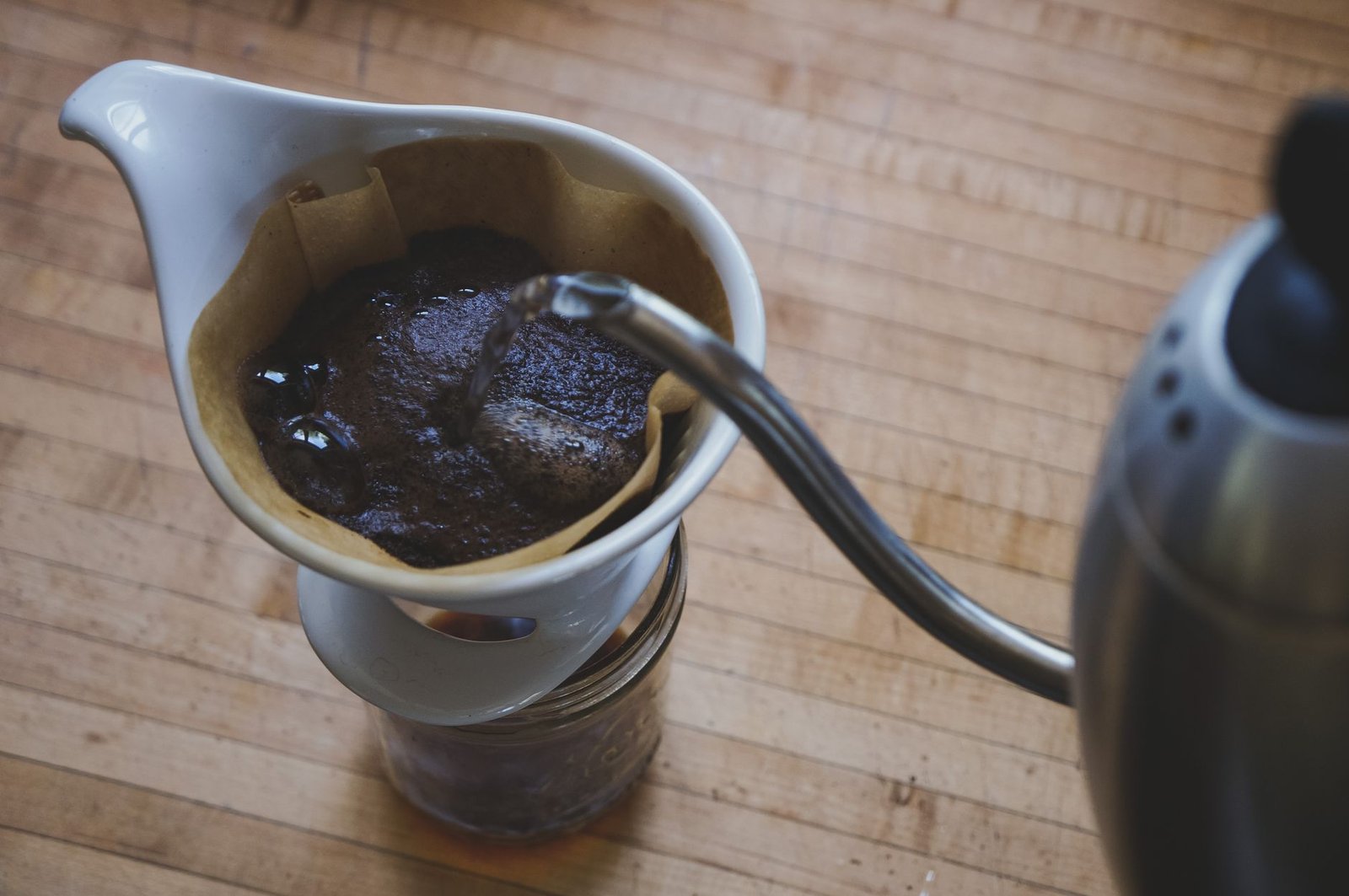
The V60 is a pour-over coffee dripper. Its cone shape and internal spiral ribs are functional design features rather than decoration.
As hot water flows through a bed of coffee, the brew is governed primarily by gravity, the resistance of the coffee bed, and the single large outlet at the base of the dripper. The ribs help reduce filter contact with the dripper wall, which can improve airflow and reduce clogging effects, while the overall geometry supports an even flow through the coffee bed.
The actual flow rate is shaped by several interacting variables:
- Grind size
- Filter type and flow resistance
- Dose of coffee and bed depth
- Pour rate and agitation
- Coffee freshness and degassing
The result is often a cup with high clarity and distinct flavour separation compared to immersion methods, though the outcome depends heavily on technique and recipe.
Pour-Over vs. Immersion Brewing: A Fundamental Difference
Pour-over brewing involves continuously or intermittently passing water through coffee grounds under gravity, whereas immersion brewing involves steeping coffee fully in water before separation.
The V60 is generally a relatively fast percolation brewer. It can produce clarity, brightness, and pronounced acidity when well executed, but it is also sensitive to grind consistency, pouring technique, and distribution of water through the bed.
The Core Variables: Ratio, Temperature, and Pour
Technique matters significantly in pour-over brewing, and small changes can meaningfully affect extraction. While equipment matters, consistency and repeatability of process are often more important than gear alone.
Coffee-to-Water Ratio
A common starting point is around 1:15 to 1:17 (coffee to water by weight), though recipes vary depending on roast level and desired strength.
Water Temperature
Typical brewing temperatures range from approximately 92°C to 96°C. Lighter roasts often benefit from higher temperatures, while darker roasts may extract sufficiently at slightly lower temperatures.
The Pour Itself
Pour technique influences extraction uniformity. A controlled, steady pour that evenly saturates the bed helps promote even extraction. Many brewers use a circular or pulse-pour approach to manage flow and maintain stability in the coffee bed.
Highly turbulent or uneven pouring can create channeling, where water finds preferential paths through the coffee bed, leading to under-extraction in some areas and over-extraction in others.
Some brewing discussions describe poor pouring technique informally as “shaky” or inconsistent pouring. While not a technical term, it generally refers to lack of control leading to uneven saturation and flow.
The Bloom: The Coffee Exhales
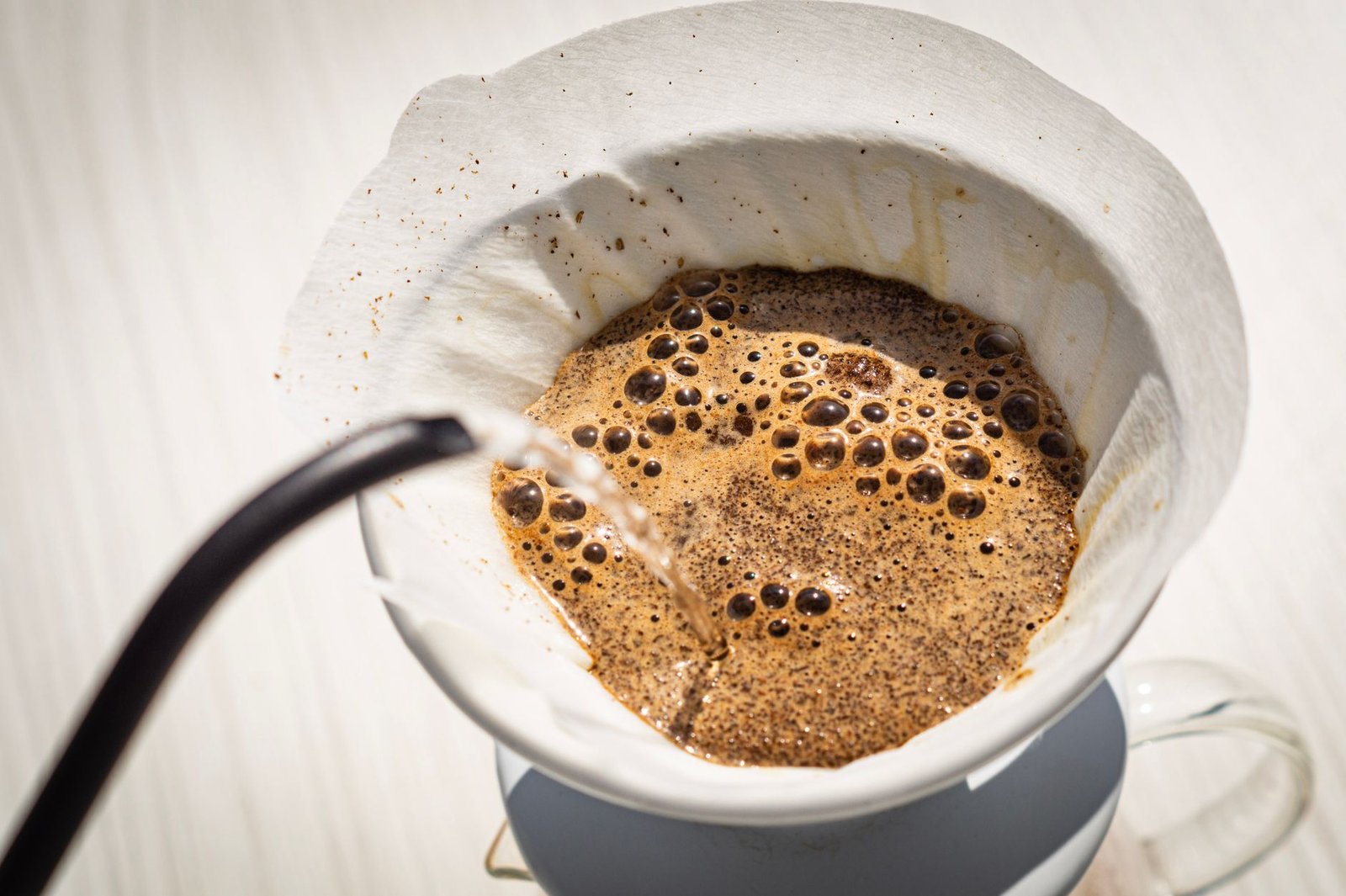
The bloom refers to the initial phase of brewing when a small amount of water is added to dry coffee grounds, causing them to release trapped gases, primarily carbon dioxide.
This degassing creates visible bubbling and expansion of the coffee bed. It is a physical release of gas rather than a chemical reaction.
Why the Bloom Matters for Extraction
Fresh coffee contains more dissolved CO₂, which can interfere with early-stage wetting if not allowed to escape. A bloom period of roughly 20–45 seconds is commonly used to improve initial saturation consistency.
However, bloom time is not a strict requirement; its importance varies depending on roast freshness and brewing approach.
The Four-Pour Method: A Step-by-Step Framework
There is no single standard “four-pour method” in professional coffee brewing, but structured multi-pour recipes are commonly used. One example structure is:
- The Bloom: Add enough water to evenly saturate the grounds and allow CO₂ to escape. Wait ~20–45 seconds.
- First main pour: Add water in a controlled manner to build extraction while maintaining an even bed.
- Optional pause: Some recipes include a short rest to allow drawdown stabilization.
- Final pour(s): Add remaining water to reach target brew weight while maintaining even saturation.
Total brew time is often between ~2:30 and ~4:00 minutes, depending on recipe, grind size, filter, and coffee type. Time should be interpreted as a diagnostic indicator rather than a fixed target.
Reading Your Brew: Grind Size and Timing
The V60 can provide useful feedback about extraction, but interpretation requires considering multiple variables together.
When the Brew Finishes Quickly
If drawdown is very fast, the grind may be too coarse, or the pour may be too aggressive, or the coffee bed may be under-extracted due to low contact time. The result is often a thin or sharp cup. Adjusting finer is one common response.
When the Brew Drains Slowly
If drawdown is very slow, the grind may be too fine, or the coffee bed may be clogged due to fines, agitation, or filter resistance. This can lead to over-extraction and bitterness. Adjusting coarser is one common response.
The Basic Diagnostic Flowchart
- Very fast drawdown: consider grinding finer or reducing flow channeling.
- Very slow drawdown: consider grinding coarser or reducing fines/agitation.
- Balanced drawdown: adjust based on taste rather than time alone.
The Art of Iteration: Why Note-Taking Changes Everything
The iterative nature of V60 brewing makes it particularly well-suited to experimentation. Each brew is influenced by multiple interacting variables, and small adjustments can produce noticeable differences in flavour.
Recording variables such as dose, grind size, temperature, and brew time can help identify patterns over time. This turns brewing into a repeatable process rather than trial-and-error guesswork.
Over time, consistent observation helps isolate what improves extraction for a given coffee. The goal is not perfection in a single cup, but repeatable understanding of how variables interact.
The result is a cup that expresses the coffee’s characteristics more clearly: origin, roast style, and processing method become easier to distinguish when extraction is well controlled.
Essential Accessories for the V60 Setup
A few tools improve consistency and control.
The V60 Itself
The dripper provides the geometry and flow characteristics that define the method.
A Gooseneck Kettle
A gooseneck kettle improves control over flow rate and placement of water. While not strictly required, it makes repeatable pouring significantly easier.
A Quality Grinder
A consistent grinder is one of the most important factors in pour-over brewing. Uneven particle size distribution can lead to uneven extraction, regardless of pouring skill. Grinding fresh just before brewing also preserves volatile aromatic compounds that degrade after grinding.
The Philosophy of V60 Brewing
In the end, the V60 is less about equipment and more about process control. It rewards consistency, observation, and incremental adjustment. It is sensitive to change, which makes it useful for learning how extraction works in practice.
With repetition, brewing becomes more predictable. Over time, small improvements in technique can lead to noticeably better clarity and balance in the cup.
Final Thoughts
The V60 pour-over method rewards attention to detail and willingness to refine technique over time. Understanding grind size, water temperature, flow rate, and distribution allows for greater control over extraction. While it can be more demanding than immersion brewing, it also provides a transparent view into how brewing variables affect flavour. With practice, consistency improves, and the method becomes a reliable way to produce high-quality coffee at home.
Leave a Reply